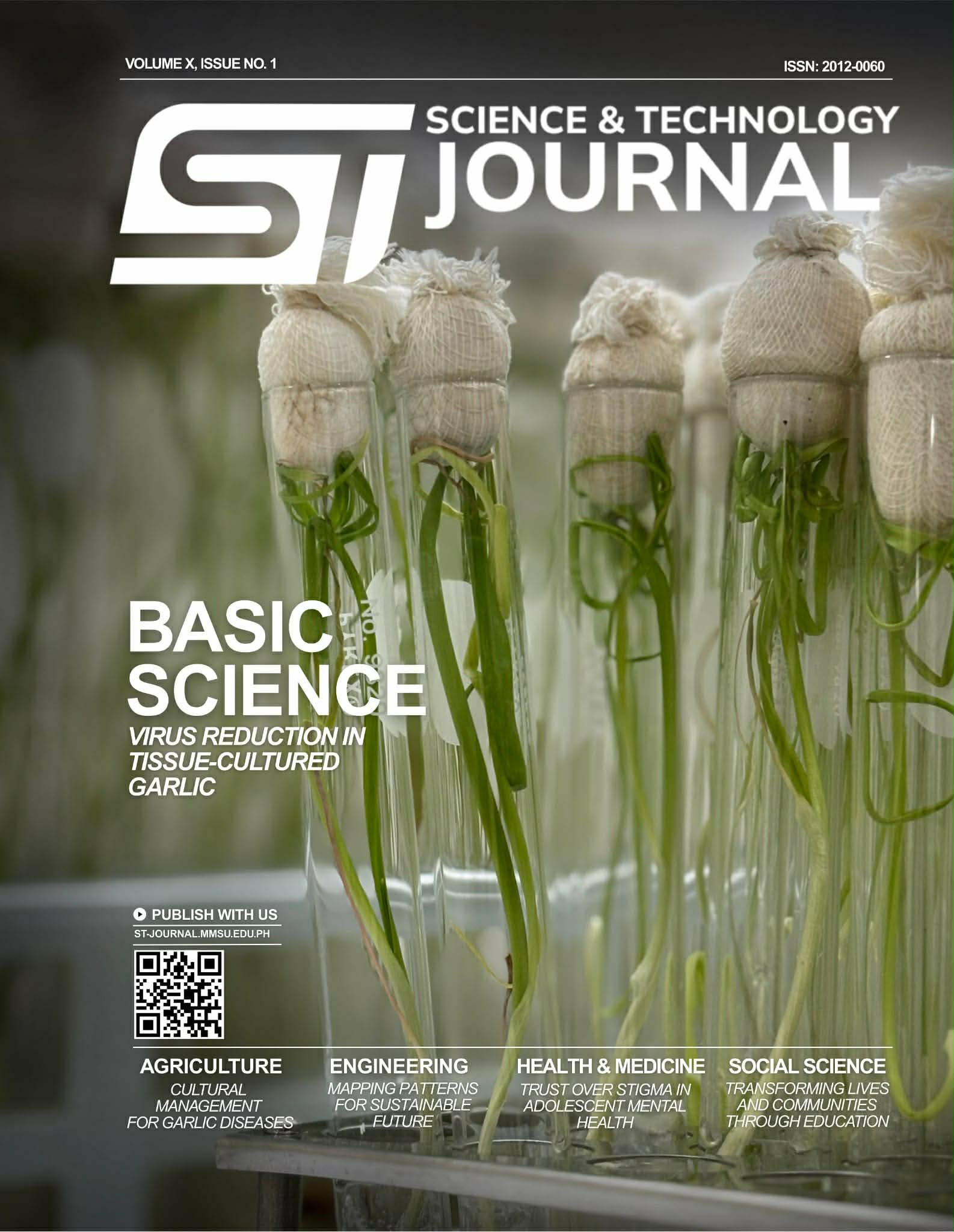
GIS-Based Land Suitability Assessment for Corn and Garlic Production in the Quiaoit River Watershed, Ilocos Norte, Philippines
DOI:
https://doi.org/10.66133/sc77ed27Keywords:
corn, garlic, GIS, land suitability, sustainable agricultureAbstract
This study assessed the land suitability for corn (Zea mays L.) and garlic (Allium sativum L.) production in the Quiaoit River Watershed (QRW), Ilocos Norte, Philippines, using a Geographic Information System (GIS)–based multi-criteria approach. By integrating soil properties, topography, climate, and water availability, the analysis aimed to identify areas where each crop can be sustainably grown and to highlight key environmental constraints affecting productivity. Soil parameters, including pH, organic matter, nutrient content, texture, depth, and drainage, were combined with slope, temperature, rainfall, and aquifer capacity data, following standards set by the FAO and the Bureau of Soils and Water Management. Factor weights were assigned using the Analytical Hierarchy Process (AHP) to reflect the relative importance of each criterion for corn and garlic production. The results indicate that much of the watershed is moderately to highly suitable for corn, particularly in gently sloping areas with deep clay loam soils, favorable pH, and reliable groundwater supply. In contrast, garlic suitability is generally moderate, constrained mainly by low soil organic matter and climatic conditions that can limit optimal bulb development. Spatial analysis showed that approximately 419.5 ha are highly suitable and 7,640 ha are moderately suitable for corn, while 8,420 ha are moderately suitable and 441 ha are marginally suitable for garlic. These patterns suggest that while the QRW has strong potential for corn production, garlic cultivation requires more careful management to address soil fertility and water-related limitations. The study highlights the value of GIS-based suitability mapping as a practical decision-support tool for agriculture. Targeted improvements in soil organic matter, efficient irrigation practices, and appropriate slope management can help overcome identified constraints and enhance crop productivity. The generated suitability maps provide a clear basis for crop zoning, land-use planning, and sustainable watershed management, supporting climate- resilient agricultural development in Ilocos Norte.
References
Amongo, R. M., Saludes, R., Gallegos, R. K., Relativo, P. L., Duminding, R. S., Pantano, A. D., Cunan, J. J. P., & Lalap-Borja, G. N. (2023). A GIS-based land suitability model for agricultural tractors in CALABARZON Region, Philippines. Scientific Reports, 13, Article 18272. https://doi.org/10.1038/s41598-023-45071-w Nature+1
Bilas, G. (2022). Land suitability analysis as a tool for evaluating soil-based agricultural potential under current and future scenarios. Land, 11(12), 2200. https://doi.org/10.3390/land11122200 MDPI
Bucao, D. S., Utrera, R. T., Galacgac, E. S., & Sagsagat, F. C. (2023). Land suitability assessment for garlic in Region I. Science and Technology Journal, 9(1), 20–35.
Consolacion, J., Marapao, G., Uy, W., Leopardas, V., Parungao, L., & Cabanilla, H. (2022). Suitability mapping of key crop commodities in Misamis Occidental, Philippines. MSU Journal of Environment and Aquatic Resources, 6, 71–85. https://doi.org/10.48031/MSUNJEAR.2022.06.05 Academia
Department of Agriculture (DA). (2023). National Color-Coded Agricultural Guide (NCCAG) Map – 2023 Update. Quezon City, Philippines.
Food and Agriculture Organization (FAO). (2020). Guidelines for land evaluation for sustainable agriculture (Soils Bulletin 32). Rome: FAO.
Malczewski, J., & Rinner, C. (2022). Multicriteria decision analysis in geographic information science (2nd ed.). Springer.
Nurmiaty, N., & Baja, S. (2022). GIS-based multi-criteria assessment of land suitability for maize and horticultural crops in Maros Region, South Sulawesi, Indonesia. Open Journal of Soil Science, 12(1), 87–101.
Salvacion, A. R. (2017). Mapping spatio-temporal changes in climatic suitability of corn in the Philippines under future climate condition. Quaestiones Geographicae, 36(1), 105–120. https://doi.org/10.1515/quageo-2017-0008 ResearchGate+1
Saaty, T. L. (1980). The analytic hierarchy process: Planning, priority setting, resource allocation. McGraw-Hill.