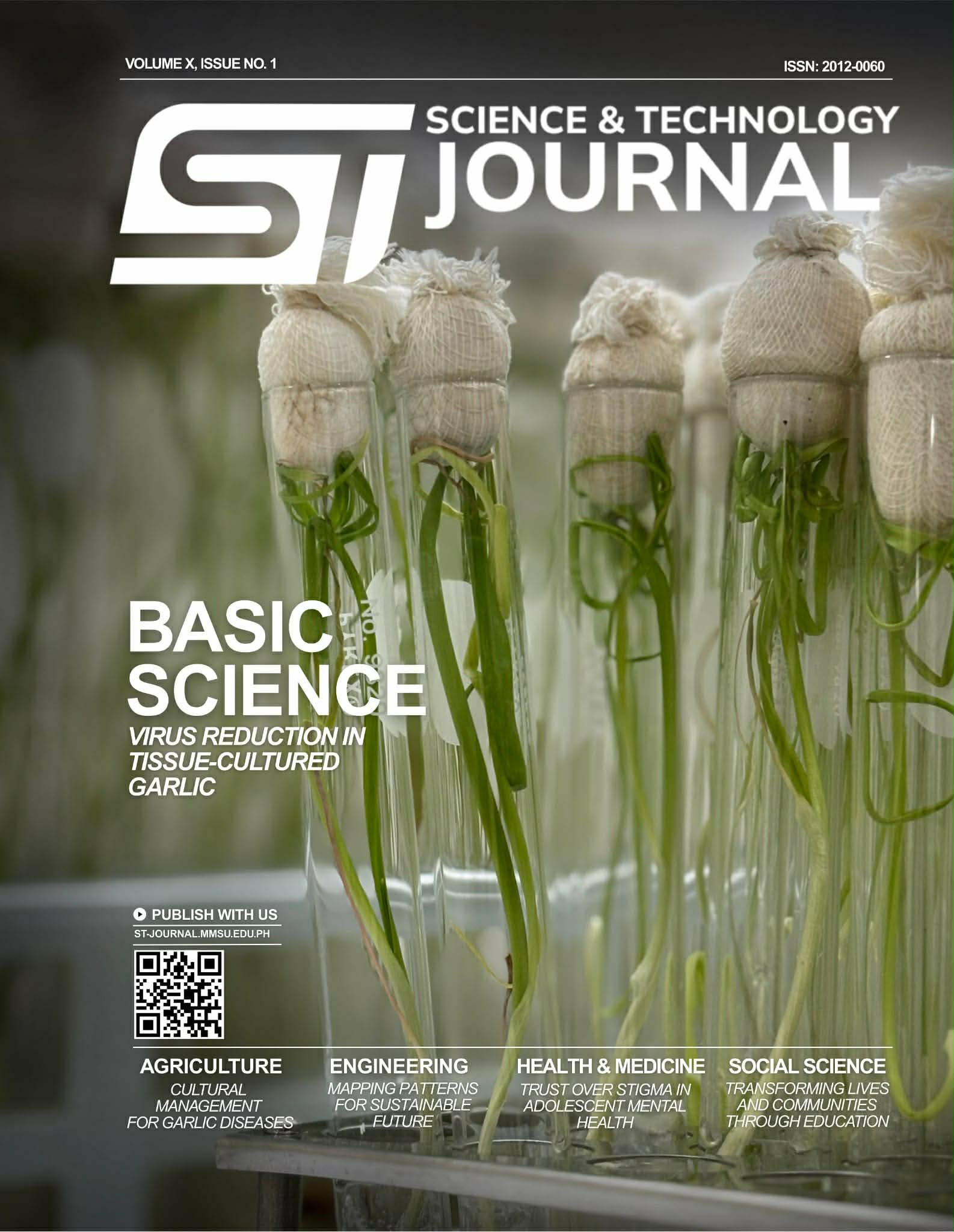
Reduced Incidence of Purple Blotch and Cercospora Leaf Spot in Garlic Through Relay Cropping and Spatial Crop Management
DOI:
https://doi.org/10.66133/d6pp0g69Keywords:
ecological pest management, garlic farming, relay cropping system, planting distance, trap and band cropsAbstract
Ecological pest management is an approach that uses compatible pest control techniques to promote sustainable production under varying environmental conditions. This study aimed to identify the effective management techniques and crop assemblages that sustain the performance of the garlic production system. The effectiveness of habitat management was evaluated using different relay cropping systems, planting distances, and trap and band crops to manage diseases, such as purple blotch (Alternaria porri) and cercospora leaf spot (Cercospora duddiae), and to improve yield. Results showed that planting six rows of garlic every two rows of tomato effectively controls purple blotch occurrence at bulb development (65.39%) and maturity stage (57.15%). Cercospora leaf spot was also reduced by up to 32.50% at maturity under a similar relay cropping system, followed by planting of six rows of garlic and one row each of tomato and corn. The inclusion of tomato and corn served as an effective biological control agent and a physical barrier because tomato exhibits antifungal properties and corn has tall height and broad leaves, which help reduce disease incidence and spread and lead to higher yields and net profits. These systems yielded 3.77 and 3.90 t ha-1 , respectively. Planting distance also significantly influences disease incidence and yield. Those garlic plants planted at a distance of 20 cm x 15 cm produced the highest yield of 2.55 t ha-1 , with an increase of 18.43% compared to other distances. The use of trap and band crops, such as marigolds and corn, also decreases pest occurrence and improved crop quality as well as attract natural enemies and pollinators. Overall, the use of relay cropping, planting distances, and integration of band and trap crop reduces disease incidence and severity, increases yield and profitability, and enhances ecological stability. Thus, reduces the use of synthetic pesticide and promotes long-term sustainability and productive garlic farming.
References
Abou-Keriasha, M. A., Gadallah, R. A., & El-Wakil, N. M. H. (2012). Effects of intra- and interspecific competition on yield and yield components of maize under different intercropping patterns. Egyptian Journal of Agronomy, 34(2), 249–265.
Ahmed, I., Khan, M. A., Khan, N., Ahmed, N., Waheed, A., Saleem, F. Y., Khan, S., & Aslam, S. (2017). Impact of plant spacing on garlic rust (Puccinia allii), bulb yield, and yield components of garlic (Allium sativum). Pakistan Journal of Agricultural Research, 30(4), 380–385.
Alam, M. S., Rahim, M. A., Bhuyan, M. A. H., Simon, P. W., & Malek, M. A. (2008). Effect of spacing on growth and yield of two lines of garlic under dry land conditions. Journal of Agroforestry and Environment, 2(2), 9–13.
Anwar, H. R. M. M., Rahim, M. A., Chowdhury, M. S. H., Haider, M. A., & Quadir, M. A. (1996). Effect of planting time and growth regulators on the growth and yield of garlic. Progressive Agriculture, 7(1), 137–142.
Azene, T., & Worku, M. (2015). Effect of spacing on incidence and severity of garlic rust (Puccinia allii) and bulb yield and related traits of garlic at eastern Ethiopia. Journal of Plant Pathology & Microbiology, 6, 314–317.
Bandyopadhyay, P. K., Singh, K. C., Mondal, K., Nath, R., Ghosh, P. K., Kumar, N., & Singh, S. S. (2016). Effects of stubble length of rice in mitigating soil moisture stress and on yield of lentil (Lens culinaris Medik.) in rice–lentil relay crop. Agricultural Water Management, 173, 91–102.
Brewster, J. L. (1994). Onions and other vegetable alliums. CAB International.
Bumble bee on marigold. (2017, November 21). Photos Public Domain. https://www.photos-public-domain.com/2017/11/21/bumble-bee-on-marigold/
Buttery, R. G., Ling, L. C., & Light, D. M. (1987). Tomato leaf volatile aroma components. Journal of Agricultural and Food Chemistry, 35, 1039–1042.
Chandio, S. A., Gilal, A. A., Rajput, L. B., Brohi, M. U., Bhatti, J. G. M. S. M. A., & Sheikh, A. (2020). Performance of various trap crops in the management of Thrips tabaci L. in onion crop. Pure and Applied Biology, 9(4), 2476–2481. https://mail.thepab.org/index.php/journal/article/view/1606
Climate Technology Centre and Network. (n.d.). Ecological pest management. https://www.ctc-n.org/technology-library/increasing-crop-resilience-and-productivity/ecological-pest-management
Dar, A. A., Sharma, S., Mahajan, R., Mushtaq, M., Salathia, A., Ahamad, S., & Sharma, J. P. (2020). Overview of purple blotch disease and its management through chemical, biological and genetic approaches. Journal of Integrative Agriculture, 19(12), 3013–3024. https://doi.org/10.1016/S2095-3119(20)63285-3
Department of Agriculture. (2021). DA-Ilocos on garlic production technologies update. https://ilocos.da.gov.ph/?p=9170
Dongre, M. A. (2023). Cercospora duddiae Welles alters the nutritional content of garlic leaves after inducing leaf spot disease. International Journal of Plant and Environment, 9(4). https://doi.org/10.18811/ijpen.v9i04.13
Egel, D. (2018). Cercospora leaf spot on beet. https://vegcropshotline.org/article/cercospora-leaf-spot-of-beet-2/
Ekroth, A. K. E., Rafaluk-Mohr, C., & King, K. C. (2019). Diversity and disease: Evidence for the monoculture effect beyond agricultural systems. https://doi.org/10.1101/668228
Eliaz, K. E., & Camalig, E. E., Jr. (2023). Growth and yield performances and viral disease screening of Philippine native garlic varieties grown in Bacnotan, La Union, Philippines. International Journal of Agronomy and Agricultural Research, 23(2), 1–10.
Fakhar, F., Biabani, A., Zarei, M., & Moghadam, A. N. (2019). Effects of cultivar and planting spacing on yield and yield components of garlic (Allium sativum L.). Italian Journal of Agronomy, 14(2), 1303. https://doi.org/10.4081/ija.2019.1303
Frison, E. A., Gold, C. S., Karamura, E. B., & Sikora, R. A. (1998). Mobilizing IPM for sustainable banana production in Africa. INIBAP.
Hansen, J. (2025). How to plant, grow and harvest garlic. https://www.gardentech.com/blog/gardening-and-healthy-living/how-to-grow-your-own-garlic
Icalia, P.J.C., Salces, A.J., Mendioro, M.S., Sevilla, C.C., Seo, K.S., and Kim, T.S., SNP analysis of the growth hormone gene in indigenous Philippine cattle, Ilocos genetic group by PCR-RFLP, in Proc. 10th World Congress of Genetics Applied to Livestock Production, Vancouver, 2014, p. 515.
Jones, H. A., & Mann, L. K. (1963). Onions and their allies: Botany, cultivation and utilization. Leonard Hill.
Liu, T., Cheng, Z., Meng, H., Ahmad, I., & Zhao, H. (2014). Growth, yield and quality of spring tomato in a tomato/garlic intercropping system. Scientia Horticulturae, 170, 159–168. https://doi.org/10.1016/j.scienta.2014.02.039
Shepard, B. M., Barrion, A. T., & Litsinger, J. A. (1987). Friends of the rice farmer: Helpful insects, spiders and pathogens. International Rice Research Institute.
Tanveer, M., Anum, S. K., Hussain, S., Cerdà, A., & Ashraf, U. (2017). Relay cropping as a sustainable approach. Environmental Science and Pollution Research, 24, 6973–6988. https://doi.org/10.1007/s11356-017-8371-4
Zhang, P. Y., Chen, K. S., He, P. Q., Liu, S. H., & Jiang, W. F. (2008). Effects of crop development on emission of volatiles in tomato leaves. Journal of Integrative Plant Biology, 50, 84–91. https://doi.org/10.1111/j.1744-7909.2007.00597.x