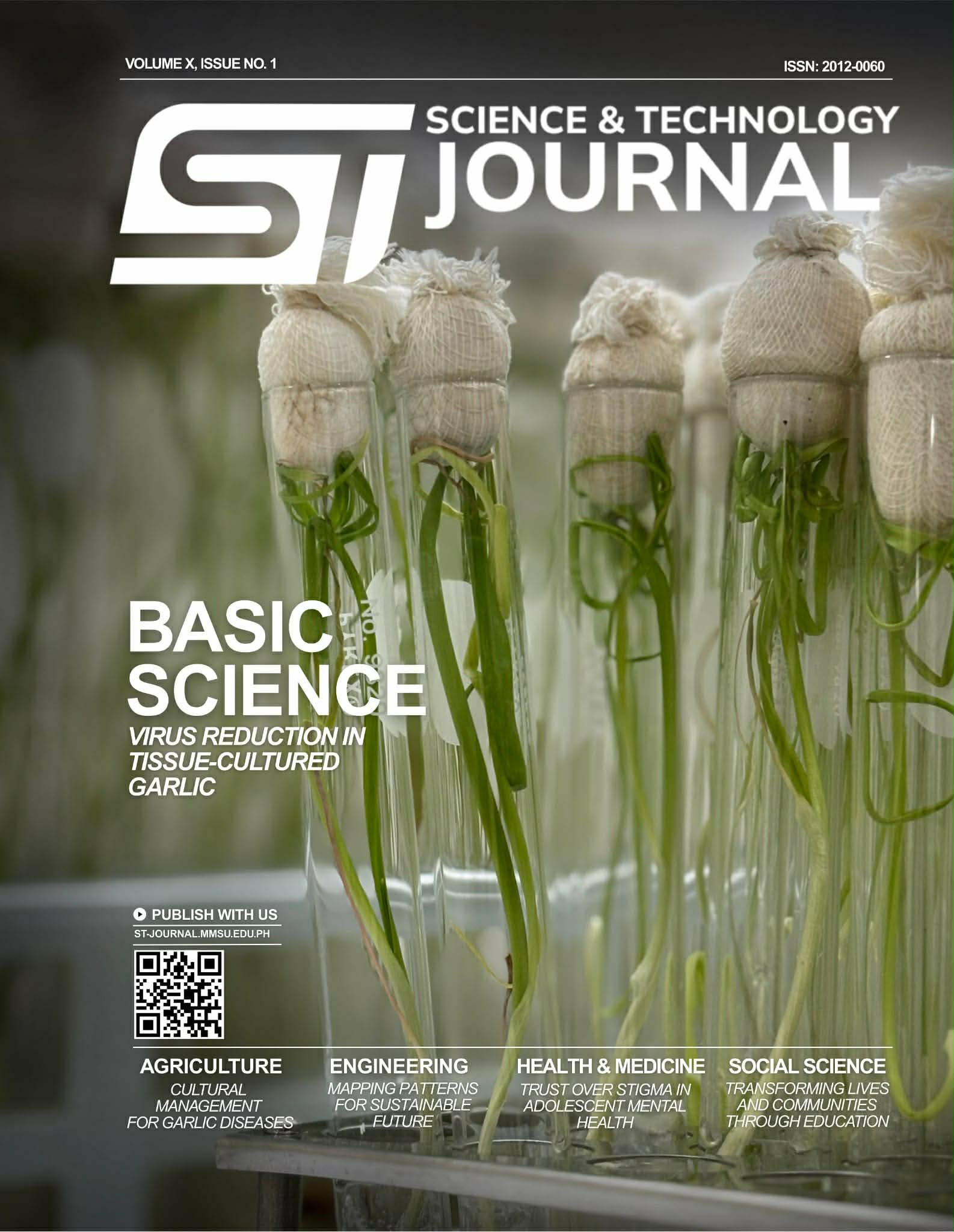
Effect of Chemotherapy and Thermotherapy on the Virus Incidence Reduction in Tissue-Cultured Ilocos White Garlic (Allium sativum L.)
DOI:
https://doi.org/10.66133/rfxx7m85Keywords:
acyclovir, garlic, thermotherapy, virus incidence reductionAbstract
Garlic (Allium sativum L.), an important crop in the Philippines, suffers from viral infections that limit local production by reducing yield and bulb quality. Garlic is propagated vegetatively; hence, the planting material from the previous harvest is planted for the next planting season, thereby viral transmission from generation to generation is inevitable. To address this, the study evaluated the virus elimination effect of chemotherapy and thermotherapy with meristem culture in Ilocos White garlic.
This study tested two virus elimination treatments – chemotherapy at 10, 20, 30, and 40mg/l acyclovir – an antiviral drug, and thermotherapy at 50°C for 1, 1.5, and 2 hours. Five viruses, namely, OYDV, SLV, GCLV, LYSV, and Allexivirus, were molecularly detected through RNA extraction and RT-PCR.
Results showed Ilocos White garlic harvested from MMSU were infected with only LYSV and Allexivirus out of five viruses screened. Chemotherapy using acyclovir reduced LYSV by 75% using 10mg/l and Allexivirus by 100% using 20 to 40mg/l. Thermotherapy at 1 and 1.5 hours reduced LYSV by 66.67% and 75%, respectively, and Allexivirus by 100% for 1, 1.5, and 2 hours. These results showed that LYSV is more virulent than Allexivirus and more resistant to treatments.
The coordinated approach of meristem culture with chemotherapy using acyclovir at 20mg/l and thermotherapy at 50°C for 1 hour showed potential virus elimination and reduction ability. Further optimization and combinations of these methods are recommended to achieve consistent and significant virus elimination in garlic essential in sustaining the local garlic industry.
References
Adorada, J. L., Bandojo, G. P., Tepper, L. M., Javier, M. E., Mondoñedo, M. O., Mercado, M. J., & Recuenco, M. O. (2023). Problem analysis of garlic cultivation in major production areas in Luzon, Philippines. Asian Research Journal of Agriculture, 16(3), 74–84. https://doi.org/10.9734/ARJA/2023/v16i3394 Asian Research Journal
Arcalas, J. E. (2024, June 5). Native garlic to raise local sufficiency to 20 percent. The Philippine Star. https://www.philstar.com/business/2024/06/05/2360361/native-garlic-raise-local-sufficiency-20-percent
Asano, S., Hirayama, Y., & Matsushita, Y. (2017). Distribution of Tomato spotted wilt virus in dahlia plants. Letters in Applied Microbiology, 64(4), 297–303. https://doi.org/10.1111/lam.12720
Baranwal, V. K., & Pramesh, D. (2015). Production of virus-free garlic (Allium sativum L.) through meristem tip culture after solar or hot air treatment of cloves. Journal of Horticultural Science & Biotechnology, 90(2), 180–186. https://doi.org/10.1080/14620316.2015.11513170
Benke, A. P., Krishna, R., Khandagale, K., Gawande, S., Shelke, P., Dukare, S., Dhumal, S., Singh, M., & Mahajan, V. (2023). Efficient elimination of viruses from garlic using a combination of shoot meristem culture, thermotherapy, and chemical treatment. Pathogens, 12(1), 129. https://doi.org/10.3390/pathogens12010129
Conci, V. C., Lunello, P., Buraschi, D., Italia, R. R., & Nome, S. F. (2002). Variations of leek yellow stripe virus concentration in garlic and its incidence in Argentina. Plant Disease, 86(10), 1085–1088. https://doi.org/10.1094/PDIS.2002.86.10.1085 PubMed
Cremer, J., Campbell, P., Steele, V., Persley, D., Thomas, J., Harper, S., & Gambley, C. (2021). Detection and distribution of viruses infecting garlic crops in Australia. Plants, 10(5), 1013. https://doi.org/10.3390/plants10051013 MDPI
Dewanti, P., Widuri, L. I., Alfian, F. N., Addy, H. S., Okviandari, P., & Sugiharto, B. (2016). Rapid propagation of virus-free sugarcane (Saccharum officinarum) by somatic embryogenesis. Agriculture and Agricultural Science Procedia, 9, 456–461. https://doi.org/10.1016/j.aaspro.2016.02.163
Gann PJI, Nandy S, Botelho FBS, Vinzant K, Khodakovskaya M, Srivastava V (2025) A vacuolar proton pump controls the post-germinative growth of rice (Oryza sativa ssp. japonica). Plant Growth Regul. https://doi.org/10.1007/s10725-025-01290-x
Highlights on garlic production in Ilocos Region, 2022. (2023). Philippine Statistics Authority (PSA), Special Release No. 2023-37. https://rsso01.psa.gov.ph/statistics/crps/node/1684057133
Karjadi, A. K., & Gunaeni, N. (2022). The effect of antiviral ribavirin, explant size, and varieties on growth and development in potato meristematic. IOP Conference Series: Earth and Environmental Science, 985, 012022. https://doi.org/10.1088/1755-1315/985/1/012022
Katis, N. I., Maliogka, V. I., & Dovas, C. I. (2012). Viruses of the genus Allexivirus: Current status and future prospects. In G. Loebenstein & H. Lecoq (Eds.), Advances in Virus Research: Viruses and virus diseases of vegetables in the Mediterranean Basin (Vol. 84, pp. 163–208). Elsevier. https://doi.org/10.1016/B978-0-12-394314-9.00005-6
Kudělková, M., Pavelková, R., & Ondrušíková, E. (2017). Virus elimination in peach using chemotherapy. Acta Horticulturae, 1155, 431–438. https://doi.org/10.17660/ActaHortic.2017.1155.64
Magyar-Tábori, K., Mendler-Drienyovszki, N., Hanász, A., Zsombik, L., & Dobránszki, J. (2021). Phytotoxicity and other adverse effects on the in vitro shoot cultures caused by virus elimination treatments: Reasons and solutions. Plants, 10(4), 670. https://doi.org/10.3390/plants10040670
Mang, S. M., Altieri, L., Candido, V., Miccolis, V., & Camele, I. (2022). Garlic (Allium spp.) viruses: Detection, distribution, and remediation attempts in a European garlic collection. Notulae Botanicae Horti Agrobotanici Cluj-Napoca, 50(3), 12779. https://doi.org/10.15835/nbha50312779
Marodin, J. C., Resende, F. V., Gabriel, A., Souza, R. J. D., Resende, J. T. V. D., Camargo, C. K., & Zeist, A. R. (2019). Agronomic performance of both virus-infected and virus-free garlic with different seed bulbs and clove sizes. Pesquisa Agropecuária Brasileira, 54, e01448.
Micua, L. (2017). Garlic, ‘white gold’ of Ilocos region. Philippine News Agency. https://www.pna.gov.ph/articles/1006060
Nam, M., Lee, Y. H., Park, C. Y., Lee, M. A., Bae, Y. S., Lim, S., ... & Lee, S. H. (2015). Development of multiplex RT-PCR for simultaneous detection of garlic viruses and the incidence of garlic viral disease in garlic genetic resources. The Plant Pathology Journal, 31(1), 90.
Nerway, Z. A. A., Duhoky, M. M. S., & Kassim, N. A. (2020). In vitro elimination of Dahlia mosaic virus by using meristem culture, electrotherapy and chemotherapy. Iraqi Journal of Agricultural Sciences, 51(2).
Panattoni, A., Luvisi, A., & Triolo, E. (2013). Elimination of viruses in plants: Twenty years of progress. Spanish Journal of Agricultural Research, 11(1), 173-188.
Pascua, M. E., Gabriel, M. L. S., Badar, A. J., Antonio, M. A., & Atis, M. I. (2012). Development of a multiplication technique for virus-free garlic planting materials. Science and Technology Journal, 2(1), 1-1.
Ramírez-Malagón, R., Pérez-Moreno, L., Borodanenko, A., Salinas-González, G. J., & Ochoa-Alejo, N. (2006). Differential organ infection studies, potyvirus elimination, and field performance of virus-free garlic plants produced by tissue culture. Plant Cell, Tissue and Organ Culture, 86(1), 103–110. https://doi.org/10.1007/s11240-006-9102-6
Rizk, M. N., Shabana, Y. M., & Ketta, H. A. (2021). Chemotherapy of potato virus Y infecting potato plants using antiviral drugs. International Journal of Virology, 17(1), 8–19. https://doi.org/10.3923/ijv.2021.8.19
Sevillano, S. (2017). DA vows to address soaring retail prices of imported garlic. Philippine News Agency. https://www.pna.gov.ph/articles/1247210
Singh, A. (2023). Meristem culture: Definition, procedure, benefits, and applications. Plant Cell Technology. https://plantcelltechnology.com/blogs/blog/blogmeristem-culture-definition-procedure-benefits-and-applications
Sulistio, M., Sulistyaningsih, E., & Subandiyah, S. (2015). Elimination of shallot bulb viruses through heat treatment. Indonesian Journal of Biotechnology, 20(2), 133–140.
Takaichi, M., Yamaguchi, T., Sano, T., & Matsumoto, K. (1998). A new potyvirus causing yellow stripe disease of garlic in Japan. Annals of the Phytopathological Society of Japan, 64(6), 559–565. https://doi.org/10.3186/jjphytopath.64.559
Torres, A. C., Fajardo, T. V., Dusi, A. N., Resende, R. D. O., & Buso, J. A. (2000). Shoot tip culture and thermotherapy for recovering virus-free plants of garlic. Horticultura Brasileira, 18, 192–195. https://doi.org/10.1590/S0102-05362000000300010
Wang, M. R., Cui, Z. H., Li, J. W., Hao, X. Y., Zhao, L., & Wang, Q. C. (2018). In vitro thermotherapy-based methods for plant virus eradication. Plant Methods, 14(1), 87. https://doi.org/10.1186/s13007-018-0355-y